
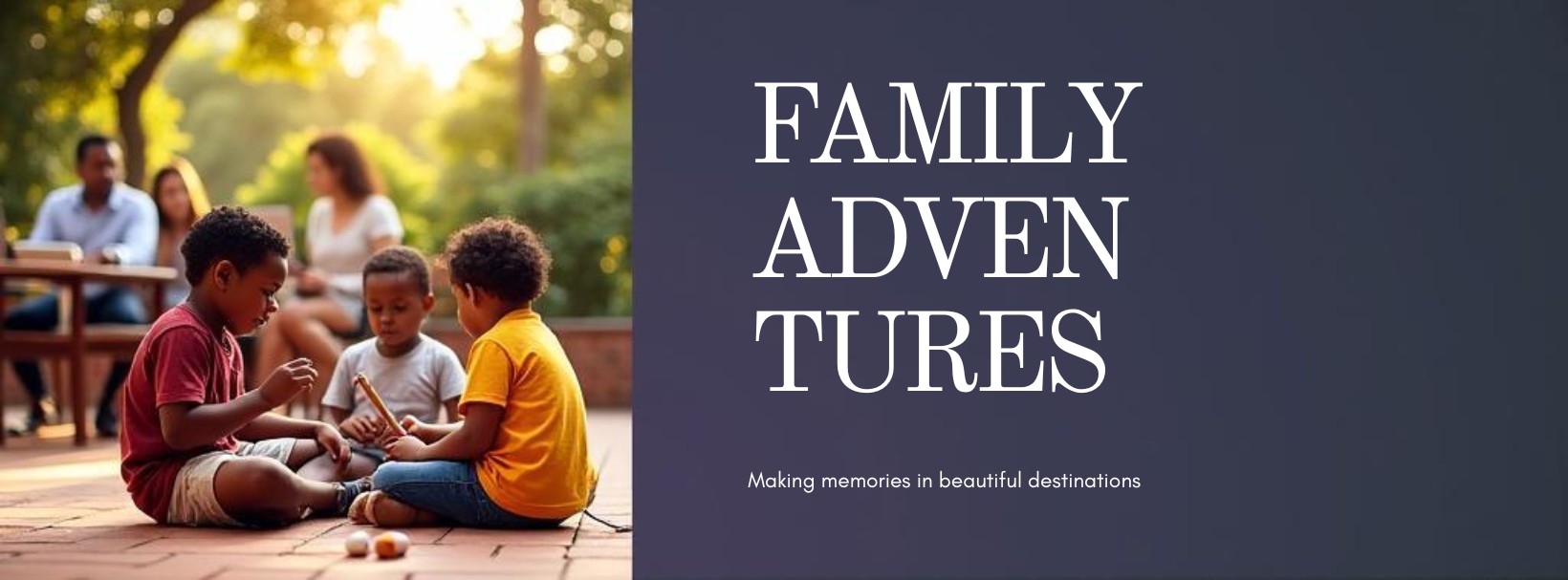
The idea sounded almost too convenient. A dozen worldschooling families, same city, same month, kids running between apartments while the adults rotate teaching duties and share the mental load of “is my child actually learning anything?” We’d been hearing about pop-up hubs for two years before we committed to joining one, and honestly, most of the hesitation was unfounded.
But it wasn’t the fairy tale either. So here’s the real version.
What a worldschooling pop-up hub actually is
For the uninitiated: a pop-up hub is when a group of worldschooling families coordinates to be in the same place at the same time, usually for four to eight weeks. Someone posts in a Facebook group or on a platform like Worldschoolers, says “we’re doing Tbilisi in March, who’s in?” and families start signing up.
There’s no official structure most of the time. No company running it, no fees beyond your normal accommodation costs. The hub is the people. Families share resources, do group lessons, take trips together, and give each other’s kids a peer group that isn’t just screen-based.
We’ve been based in Mauritius for most of the year, which is wonderful for many reasons and completely useless for building a worldschooling community, because almost nobody lands here for a month to do it. So the hubs we’ve joined have been elsewhere: one in Portugal, one in Mexico, kids ranging from Simmi at 3 to Krishav at 8 to Indra at 10.
The part that actually works: the kids figure out the rest
Within about 36 hours, Indra had found his people. He attached himself to a 12-year-old from a Dutch family and a 9-year-old from Canada, and the three of them spent a week building some elaborate game involving sticks and rules that changed daily. I have no idea what they were learning. I’m fairly confident they were learning something.
Krishav is our slower-to-warm-up kid. At school in Mauritius he takes weeks to make friends. At the hub he was playing football in the courtyard by day two. Something about the setup accelerates the social stuff in a way that regular travel just doesn’t — maybe it’s the physical proximity, everyone on the same street or in the same building, the constant low-level option to knock on a door. It removes the friction.
Simmi mostly ate other people’s snacks and was universally adored. That’s its own kind of education, I suppose.
The thing pop-up hubs actually solve is isolation. Worldschooling can get lonely in a way that’s hard to explain to people who haven’t done it. You’re with your own family constantly, which is mostly great, but kids need other kids in a way that parents genuinely cannot manufacture. The hub fixes that problem almost immediately, and that alone is worth it.
The shared learning piece is hit or miss
Most hubs do some version of group learning. Families rotate: one parent runs a maths session Monday, another does a nature walk Wednesday, someone else hosts Spanish lessons on Friday. In theory this distributes the teaching load. In practice it depends entirely on who shows up.
We had one dad in Portugal who was a former biology teacher and ran these outdoor sessions that the kids actually looked forward to. We also had a session run by a very well-meaning mother who handed everyone worksheets and then seemed surprised that no one wanted to do them.
Lisa runs our kids’ main curriculum, a mix of the IB framework we use at home plus whatever rabbit holes the kids fall into, and she took on a writing workshop at the hub that went down well. But she spent about as many hours prepping that as she would have just teaching our own three. The sharing-of-load thing is real but it requires some coordination upfront, figuring out what level each family is working at and what the kids actually need.
If you go in expecting the group learning to replace your own teaching, you’ll be disappointed. Treat it as a supplement, extra input, a change of context, a chance for your kid to hear something from someone other than you, and it delivers.
Logistics: the stuff nobody posts on Instagram
Finding accommodation that works is harder than it sounds. You want to be close to the other families, ideally same building, but you also need enough space to actually do schoolwork. One-bedroom apartments with three kids and a shared kitchen table do not produce focused learning environments at 10am. We’ve learned this the hard way.
Most hubs coordinate via WhatsApp. There’s always a side channel for logistics and another one for activities, and there’s always some drama. Dietary restrictions, conflicting schedules, the family that signed up and then bailed two weeks before. Go in with low expectations for the organisation and genuine warmth for the people and you’ll be fine.
Budget-wise, a pop-up hub month doesn’t cost more than a regular travel month. Sometimes it costs less, because you’re renting a proper apartment instead of hotel-hopping, and group dinners at someone’s place are cheaper than restaurants every night. For us, roughly €4,000 to €5,000 for the month including accommodation, food, and activities for five people out of Mauritius. That’s actually on the reasonable end for what we’d spend travelling anyway.
Who it’s for, honestly
Pop-up hubs work best when your kids are old enough to engage with other kids semi-independently, so probably 6 and up. Simmi at 3 got something out of it, but mostly it meant Lisa and I were chasing her while also trying to participate. It wasn’t her time yet.
If you’re new to worldschooling and anxious about isolation or whether your kids are keeping up academically, a hub is one of the better things you can do. The community takes the edge off the doubt. Seeing other families, kids who are clearly fine, a bit feral but fundamentally curious, does something for your confidence that no amount of reading reassures you of.
If you’re further along and your kids have a rhythm, it’s less urgent but still worth doing occasionally. We came back from Portugal with two families we’ve stayed in touch with, a month the kids still talk about, and some renewed conviction that this whole thing is less crazy than it sometimes feels from inside it.
We’re looking at Southeast Asia next. Indra has been lobbying for Thailand. Krishav wants wherever has the best street food. Simmi wants the one with the swimming pool, which honestly is not a bad selection criterion.
She’s not wrong. Always optimise for the swimming pool.